
A Gamer’s Pilgrimage from Black Myth: Wukong to the Heart of Journey to the West
Black Myth: Wukong and Journey to the West intertwine mythic combat, redemption arcs, and deep Chinese folklore for immersive storytelling.
When the first trailer for Black Myth: Wukong dropped years ago, Alex felt his pulse quicken. The fluid combat, the towering bosses, the whisper of Chinese mythology woven into every frame—it all called to him. In the autumn of 2024, he finally took control of the Destined One, a silent warrior who carried the weight of a legend on his shoulders. The Destined One’s weapon, a magical staff that could extend and shrink, felt impossibly satisfying. Alex had no idea then that the staff was a replica of the Ryu Jingu Bang, the very same weapon wielded by Sun Wukong, the Monkey King, in a 16th-century novel.
Months after his first playthrough, the game still haunted him. He’d mastered every stance, memorized enemy patterns, and unearthed hidden lore fragments. Yet something was missing. The world Game Science had built brimmed with references he half-understood: a mention of the Pilgrim Tang Sanzang, the whisper of a 500-year imprisonment, a fleeting image of a monk crossing a desert. Alex realized he was standing at the edge of a deeper story, one that had fueled Chinese imagination for centuries.
He walked into a dusty indie bookstore in Chengdu in early 2025 and asked for Journey to the West. The shopkeeper handed him a revised four-volume paperback edition, its covers illustrated with swirling clouds and mythical beasts. Alex thumbed through Volume 1—576 pages of dense, poetic prose. The other three volumes, each roughly 450 pages, sat waiting in their slipcase like sealed chambers of a grand temple. He bought the whole set, a compact box that promised 2,346 pages of adventure.
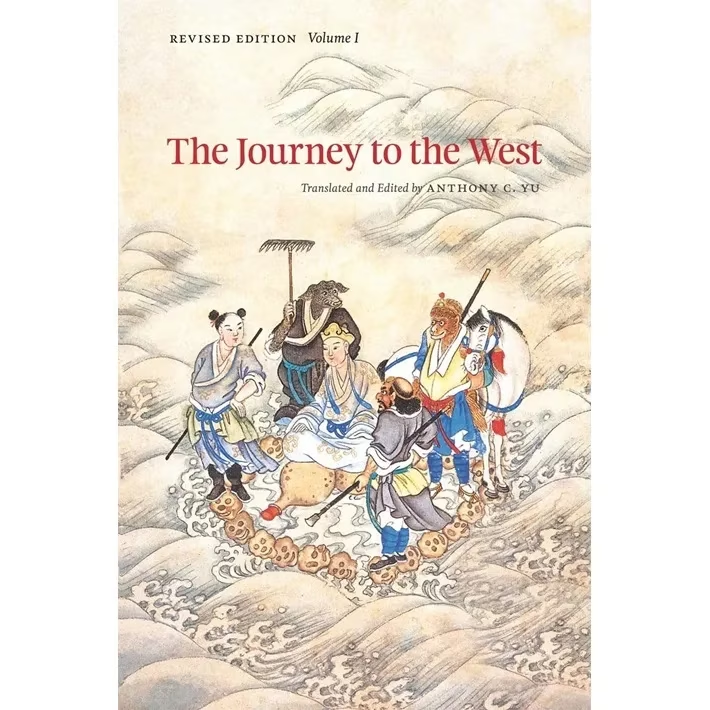
Reading became a ritual. Every evening, after long hours at his programming job, Alex opened the yellowed pages. The novel, published during the Ming dynasty, blended real history with folkloric fantasy. He learned that Tang Sanzang was based on Xuanzang, a 7th-century Buddhist monk who genuinely trekked westward to India in search of sacred scriptures. In the game, Alex had glimpsed a frail monk beset by demons; in the book, that monk became a complex figure—devout, sometimes naive, utterly reliant on his supernatural guardians.
Among those guardians, Sun Wukong blazed brightest. The novel revealed a monkey born from stone, who defied the Jade Emperor and the celestial armies, stole peaches of immortality, and was finally imprisoned beneath a mountain for 500 years. That punishment, Alex realized, mirrored the game’s opening scene where the Destined One battles a stone colossus in a chrysalis of karma. The novel framed Wukong’s escort of Tang Sanzang as an act of atonement—each demon vanquished a penance for past hubris. In the game, the Destined One’s own journey followed that same arc of redemption, though told through punishing boss fights and cryptic item descriptions.
By spring 2026, Alex had finished all four volumes. The story had reshaped his understanding of the game. That optional secret boss with the golden eyes? Not a random monster but the reincarnation of the Bull Demon King, a tragic figure who once befriended Wukong. The shape-shifting enemies? Reflections of the novel’s countless yaoguais, each with their own tragic backstory. Even the elusive “true ending”—the one players spent hundreds of hours unlocking—felt like a direct dialogue with Wu Cheng’en’s original intent: liberation, not just victory.
He wasn’t alone in this discovery. Online forums buzzed with fans trading anecdotes about reading Journey to the West. Streamers did live readings of dramatic passages between attempts at no-damage runs. A fan-created mod, "Pilgrim’s Path," even inserted novel-accurate dialogue into key cutscenes. The game, once a standalone souls-like masterpiece, had become a gateway. For Alex, it was more than that. It was the torchlight that illuminated a 500-year-old narrative cathedral.
What surprised him most was how the novel continued to ripple through modern culture. As he discussed the book with friends, connections surfaced everywhere. Dragon Ball’s Goku was directly inspired by Sun Wukong. The anime One Piece borrowed elements of the westward pilgrimage. Even the classic game Enslaved: Odyssey to the West, which he had played years ago, suddenly made profound sense. The influence wasn’t subtle—it was tectonic.
Now, in 2026, Alex manages a weekly book club within a Black Myth: Wukong fan community. Each week, the group dissects a chapter, mapping it to in-game locations like the New West or the Flaming Mountains. They note how the Destined One’s transformations—from a nimble insect to a towering rock giant—echo Wukong’s famous 72 earthly transformations. They debate whether the game’s fragmented storytelling honors the novel’s episodic structure or deliberately obscures it. Every session ends with someone picking up the controller to revisit a foggy shrine and face a forgotten guardian with new eyes.
A few days ago, Alex opened Volume 1 again. The spine was cracked, the margins filled with tiny pencil notes. He read the first line aloud: “There was a rock that since the creation of the world had been worked by the pure essences of Heaven...” He smiled, remembering the game’s tutorial area, where the Destined One awoke in a mountain glade. For millions of players, the game was a challenge to conquer. For him, it had become a pilgrimage—one that began with a staff strike and ended in the pages of an ancient, unshakable tale.
He placed the book down, picked up his controller, and started a fresh New Game Plus run. This time, he would listen to every voice line, read every inventory item description, and honor the story behind the spectacle. Because now he knew: the real victory wasn’t defeating the final boss. It was finding the sacred texts hidden in plain sight.