
A Player's Perspective on Modern Gaming
Gaming in 2026 offers immersive experiences and vibrant communities, making every session more personal and engaging than ever before.
You know, as a regular player who's been around the block a few times, I often think about what makes gaming in 2026 so special. It's not just about the flashy graphics or the massive open worlds anymore, though those are certainly impressive. For me, it's about the connection—the feeling of being part of a story, a community, or even just a moment of pure, unadulterated fun after a long day. The landscape has shifted so much, and honestly, I'm here for it. The tools we have now, the ways we can express ourselves and share our experiences, it all feels more personal and accessible than ever before. It's like the barrier between just playing a game and truly living in its world has gotten thinner, and I find myself more invested in these digital adventures than I ever thought possible.
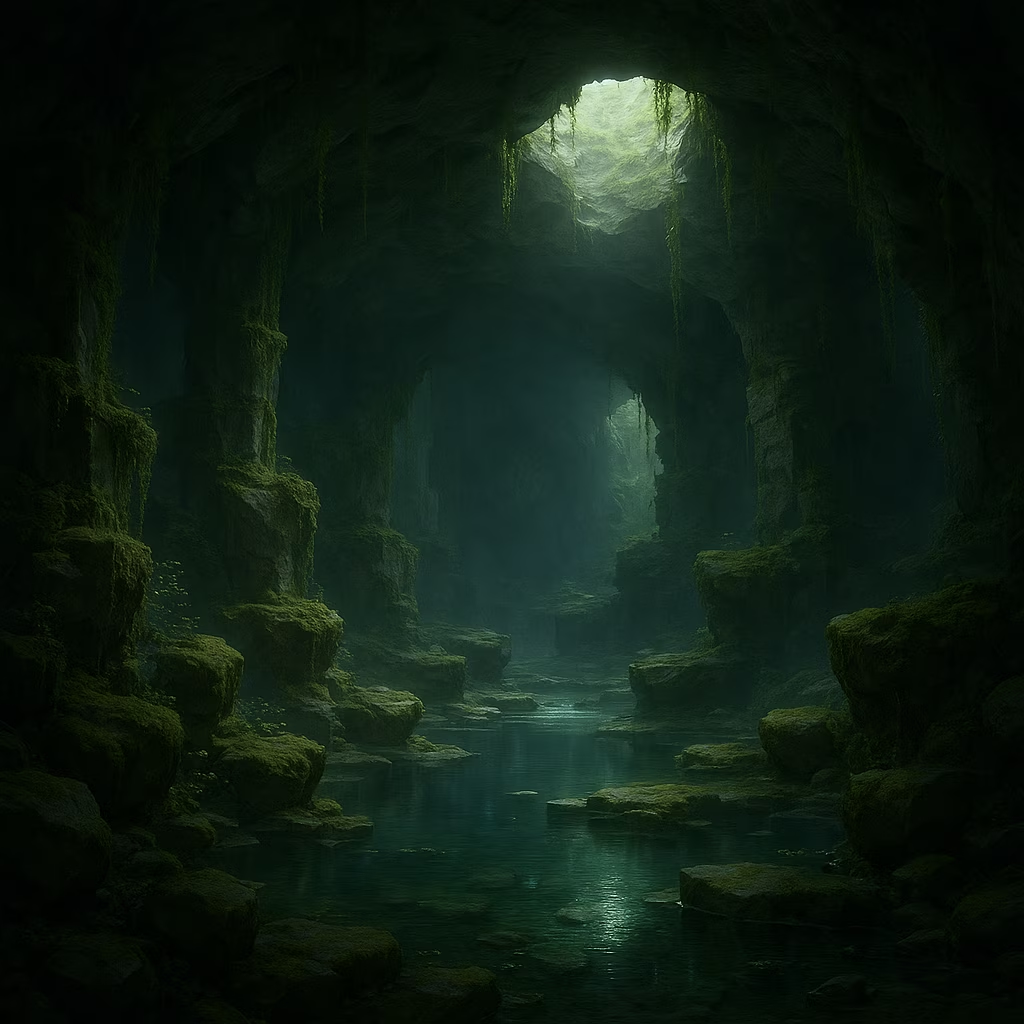
Let's talk about the games themselves. The variety is staggering. I remember when you could pretty much categorize everything into a handful of genres. Now? Good luck. We've got narrative-driven experiences that feel like interactive movies, sprawling survival-crafting sandboxes that eat up hundreds of hours, and hyper-competitive arenas that test your reflexes and strategy to the limit. And the coolest part? Many of these worlds are built with player agency in mind. My choices matter, my playstyle can shape the outcome, and sometimes, the community itself becomes a part of the game's evolving lore. It's no longer a passive experience; it's a collaboration between the developers and us, the players.
But with great power comes... well, you know. The responsibility to manage our time and engagement. This is something I've had to learn the hard way. The live-service model, battle passes, daily quests—they're designed to be engaging, sure, but they can also feel like a second job if you're not careful. I've had to set my own boundaries. It's okay to skip a season. It's fine to not complete every single challenge. The game will still be there, and my enjoyment shouldn't be tied to a fear of missing out. Finding that balance between diving deep into a game I love and maintaining a healthy offline life has been one of my biggest gaming achievements in recent years.
Of course, the social aspect is a huge piece of the puzzle. Gaming has become one of my primary ways to hang out with friends, especially since we're all scattered across different cities. Jumping into a co-op session, tackling a tough raid boss, or just messing around in a virtual space—it's our digital living room. The tools for communication are seamless now. Crystal-clear voice chat, intuitive emotes, and even shared virtual environments make it feel like we're in the same room. And it's not just about existing friendships. I've met some incredible people through gaming, folks I never would have crossed paths with otherwise. We've shared triumphs, suffered hilarious defeats, and built memories that are just as real as any from my "real" life.
Looking at the hardware and technology, it's mind-boggling what's available to an average player like me. Cloud gaming has finally hit its stride, letting me play demanding titles on devices that would have laughed at the idea a few years ago. Haptic feedback in controllers is so nuanced I can feel the difference between walking on grass and gravel. And while full-dive VR isn't quite mainstream yet, the immersive headsets we do have offer experiences that are genuinely transportive. I don't need a super expensive rig to have a fantastic time; the options are more democratized than ever. This accessibility means the community is richer and more diverse, which only makes the whole ecosystem better.
So, what's the core of it all for a player like me in 2026? It boils down to a few key things:
-
Choice and Agency: I have more control over my experience than ever.
-
Connection: It's a powerful tool for building and maintaining relationships.
-
Balance: Learning to play on my own terms is crucial for long-term enjoyment.
-
Wonder: The technology continues to deliver moments of genuine awe and surprise.
It's a fantastic time to be a player. The games are more ambitious, the communities are more vibrant, and the technology keeps pushing the boundaries of what's possible. It's not without its challenges—monetization models can be predatory, online toxicity is still a problem, and the sheer volume of releases can be overwhelming. But at its heart, gaming in 2026 remains this incredible portal to adventure, creativity, and human connection. And as long as that spark is there, I'll keep logging in, ready for the next journey.