
Black Myth: Wukong Review Scores: A 2026 Look Back at the Monkey King's Metacritic Legacy
Black Myth: Wukong’s Metacritic score evolved as stunning combat, patches, and player reception reshaped its 82-point legacy.
In the grand carnival of entertainment criticism, review scores are the equivalent of a fortune cookie written by a committee of strangers—sometimes prophetic, often baffling, and occasionally just a bit soggy. Back in 2024, Black Myth: Wukong stepped into this carnival with an 82 on Metacritic, a number that made some players cheer, some shrug, and a few armchair analysts nearly spill their energy drinks. Now, in 2026, the dust has settled, the patches have landed, and the Monkey King's debut has become a fascinating case study in how a game's reputation can evolve long after the review embargo lifts.
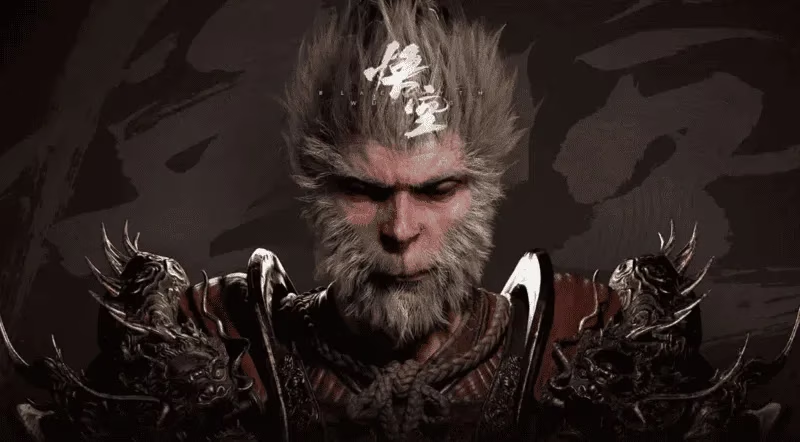
The 82 That Launched a Thousand Hot Takes
When the review embargo broke, about 55 reviews coalesced into that 82. It was a good score, not a legendary one, and that gap between 'good' and 'Game of the Year contender' became the internet's favorite chew toy. Some outlets handed out perfect scores and declared it a GOTY frontrunner, praising the breathtaking world, the boss fights that felt like choreographed chaos, and an overall experience that somehow felt special. Others nodded politely at the visuals while pointing at technical issues, story flaws, and levels that were gorgeous but sometimes emptier than a philosopher's wallet.
The aggregate score, however, was never the whole story. Metacritic is a compass, not a treasure map. With 55 reviews, a few extra points here or there would not have changed the destination much. What mattered more was how the game landed with actual players—and in 2026, that landing looks very different from the turbulent review window.
What Critics Loved, What Critics Grumbled About
The praise was loud and consistent. Black Myth: Wukong used Unreal Engine 5 to conjure environments that made eyeballs file formal complaints about being spoiled. Boss fights were the main event, a parade of mythological beatdowns that demanded reflexes, pattern recognition, and a certain willingness to die repeatedly with dignity. Many reviewers called it a true action RPG, with combat variety that rewarded experimentation. The Soulslike influences were obvious, but the game stood on its own two feet—no small feat when every action game with a dodge button gets compared to FromSoftware's dynasty.

The grumbles were equally consistent. Technical issues, performance hiccups, and a need for more patches were common refrains. Some felt the story was fun but flawed, like a blockbuster movie with a third act written on a napkin. Others noted that the levels, while stunning, sometimes offered little to do beyond staring at them. It was a classic case of style versus substance, and the jury was split.
| Aspect | Praise | Criticism |
|---|---|---|
| Visuals | Unreal Engine 5 showcase, breathtaking | Occasional performance issues |
| Boss fights | Incredible, memorable, challenging | Difficulty spikes for some |
| Combat | Varied, satisfying action RPG | Soulslike comparisons sometimes overwhelming |
| Story | Fun, ambitious | Flawed pacing, uneven writing |
| Levels | Beautiful | Sometimes empty of meaningful interaction |
The 2026 Aftermath: Patches, Players, and Perspective
Fast forward to 2026. The Monkey King has not exactly faded into obscurity. Post-launch patches have smoothed many of the technical rough edges that critics flagged. The game's community has dissected every frame, every boss, every hidden piece of lore. Mods have appeared, challenge runs have multiplied, and the phrase 'Soulslike' has been argued about in forums until the word itself filed for workers' compensation.
Game Science, the studio behind the game, has continued to support it. DLC has been discussed, anticipated, and theorized about with the intensity of a conspiracy convention. Whether or not every promised update has materialized, the game's player base remains engaged. In an industry where games are often forgotten within weeks, that is a victory.
More importantly, the 82 Metacritic score now reads less like a verdict and more like a snapshot. It captures a moment when critics had to balance awe against technical reality. In 2026, players have the benefit of hindsight, patches, and a mature community. Many who bounced off at launch have returned. Others who waited for a sale have discovered a game that, for all its flaws, offers something memorable.
So, Should You Care About the Score?
Review scores are useful, but they are not destiny. Black Myth: Wukong is a prime example. An 82 is respectable, but it does not capture the thrill of a perfectly timed dodge, the awe of a hidden area, or the satisfaction of finally toppling a boss that has been treating you like a training dummy. It also does not capture the frustration of a crash at the wrong moment or a story beat that lands with a thud.
In 2026, the better question is not 'what did Metacritic say?' but 'what does the game say to you?' If you love action RPGs, mythological spectacle, and boss fights that feel like epic poems written in bruises, then the Monkey King's adventure is worth a look. If you demand polished technical performance and airtight storytelling, you may still find some rough edges. Either way, the conversation has matured. The game has matured. And the Monkey King, as always, is still grinning.
The analysis is based on coverage from VentureBeat GamesBeat, where industry reporting often frames games like Black Myth: Wukong not just through launch reviews but through their longer commercial and technical trajectory. That lens helps explain why an 82 Metacritic score can age differently once patches, community engagement, and ongoing studio support reshape how players judge the overall experience.