
China's GPU Revolution: Lisuan Tech Launches 6nm 7G106 & 7G105 with RTX 4060-Beating Power
Lisuan Tech debuts its 6nm G100 GPUs—the 7G106 for gaming and 7G105 for AI—challenging silicon giants from Shenzhen.
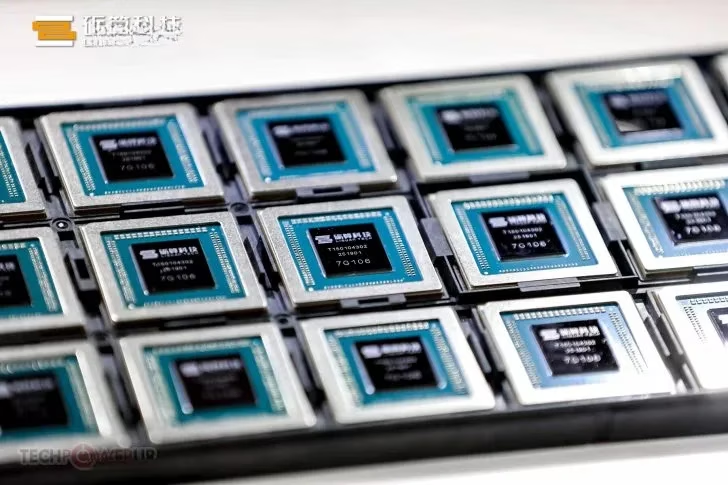
The year 2025 marked a tectonic shift in the global silicon landscape. From the bustling tech hubs of Shenzhen, a challenger emerged that would send ripples through the dominance of established giants. Lisuan Tech, a name previously whispered only in niche engineering circles, unveiled its first domestically produced 6-nanometer GPUs, cracking the code of high-performance graphics processing with a pair of cards that blend gaming prowess and artificial intelligence acceleration. The debut of the G100 architecture was not merely a product launch; it was a declaration of technological sovereignty, a narrative of a nation determined to forge its own computational destiny.
The Dual-Headed Dragon: Gaming and AI Converge
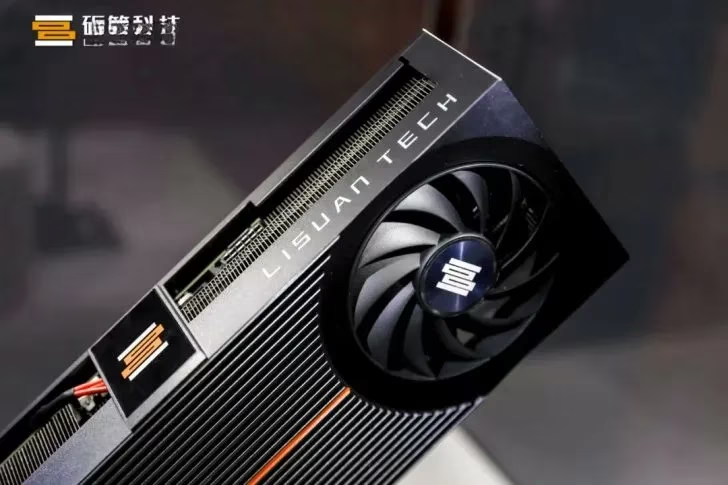
Lisuan Tech\u2019s strategy was brilliantly bifurcated. They didn't just release a single card; they unleashed a pair of silicon siblings tailored for distinct battlefields. The consumer-focused 7G106 was the vanguard for gamers, a harbinger of smooth frame rates and high-fidelity visuals. Standing beside it was the professional-grade 7G105, a computational beast engineered for the grueling demands of artificial intelligence workloads, data science, and virtualized environments. Both hearts beat with the same G100 silicon, yet their spirits were calibrated for vastly different quests.
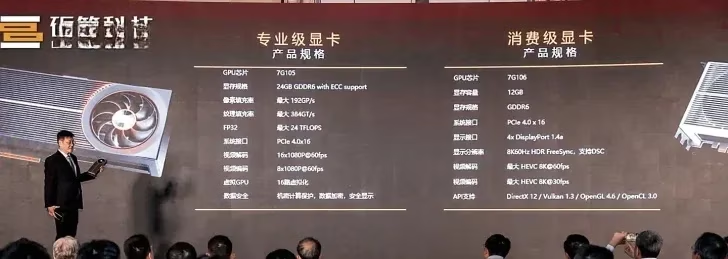
The 7G106, a triple-fan behemoth clad in a triple-slot shroud, arrived armed with 12 GB of GDDR6 memory. This visual powerhouse coursed data through a wide 192-bit bus, achieving bandwidth figures that placed it in direct contention with green team\u2019s popular mid-range offerings. With 192 Texture Mapping Units and 96 Render Output Units orchestrating the pixel pipeline, the card drew a manageable 225W through a standard 8-pin connector, a testament to the efficiency of the 6nm process node. The connectivity suite looked to the future, offering four DisplayPort 1.4a headers capable of driving 8K HDR displays at 60Hz with FreeSync fluidity. Its multimedia engine flexed with AV1 encoding for crisp streaming and hardware decoding for the latest HEVC standards.
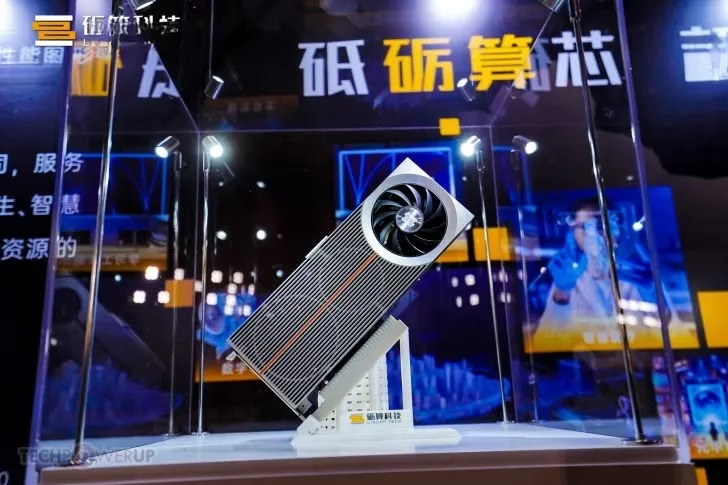
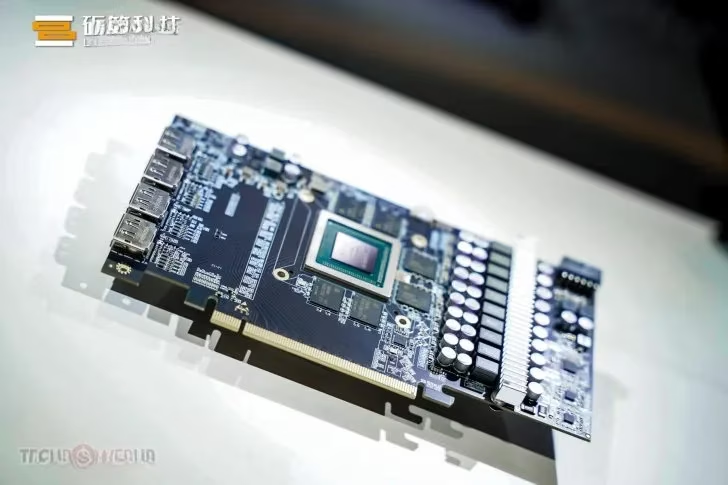
For the dreamers and builders of artificial intelligence, the 7G105 doubled down on capacity. It boasted a massive 24 GB GDDR6 frame buffer, a critical necessity for large language models and complex neural network training where every megabyte counts. More importantly, it featured Error Correction Code (ECC) memory, a guardian against data corruption that ensures calculation integrity during marathon compute sessions. This professional variant traded the single 8-pin connector for a modern 12V-2x6 power interface, signaling its readiness for dense server racks. It promised a fortress of digital security with built-in data encryption and confidential computing capabilities, allowing it to drive up to sixteen 1080p displays simultaneously within sprawling virtual ecosystems.
Synthetic Showdowns and Silicon Velocity
Skepticism was met with hard numbers. In the realm of synthetic litmus tests, the Lisuan 7G106 punched with the weight of a seasoned contender. When fired up in the classic firefight of 3DMark Firestrike, the card posted a score of 26,800 points. This placed it in a statistical dead heat with the NVIDIA GeForce RTX 4060, a remarkable feat for a first-generation architecture from a newcomer.
The board\u2019s computational muscles were further flexed in Geekbench\u2019s OpenCL benchmarks, a suite that measures raw parallel processing might. Here, the narrative grew even more compelling. The Lisuan silicon didn't just match the RTX 4060; it shadowed the more potent RTX 5060 and even the Intel Arc B580, closing a gap that many industry analysts thought unbridgeable for a debut product. It was clear that the G100\u2019s transistor arrangement was optimized for modern API overhead, supporting DX12, Vulkan 1.3, and OpenGL 4.6 with native agility.
| Benchmark Scenario | Lisuan 7G106 | NVIDIA RTX 4060 | Performance Delta |
|---|---|---|---|
| 3DMark Firestrike | 26,800 pts | 28,558 pts | ~6% behind |
| Geekbench OpenCL | 111,290 pts | 101,028 pts | ~10% ahead |
| Tomb Raider (4K High) | 80+ FPS | ~75-80 FPS | Competitive |
Wukong in the Cloud: The Real-World Crucible
Numbers in a vacuum mean little to the player holding a controller. The true baptism of fire came inside the mythical landscapes of Black Myth: Wukong. Running at a grueling 4K resolution with settings dialed to \u2018High\u2019, the 7G106 silenced doubters by delivering a buttery-smooth experience exceeding 70 FPS. It was a moment of revelation\u2014a domestic GPU rendering one of the most demanding Unreal Engine 5 titles without crumbling.
The testing gauntlet continued. In the dark, unforgiving world of Wuchang: Fallen Features, the frame counter again soared past the 70 FPS threshold at 4K. Older DirectX 12 stalwarts like Shadow of the Tomb Raider practically flew, breaking the 80 FPS barrier with ease. The magic behind this fluidity was partially attributed to Lisuan\u2019s in-house upscaling wizardry, the NRSS (Neural Rendering Super Sampling) technology. While the company remained coy about the specific AI model underpinning NRSS, they boldly claimed parity with established temporal giants like NVIDIA\u2019s DLSS and AMD\u2019s FSR, a necessary innovation to fill the pixel gaps of high-resolution rendering.
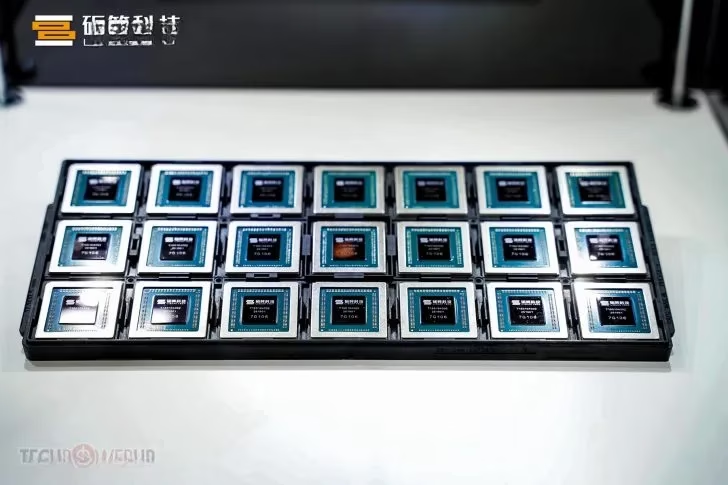
Specifications at a Glance \ud83d\udd0d
The divergence between the two models was a masterclass in product segmentation:
| Component | Lisuan 7G106 (Gaming) \ud83c\udfae | Lisuan 7G105 (AI/Pro) \ud83e\udd16 |
|---|---|---|
| GPU Architecture | G100 (6nm) | G100 (6nm) |
| Memory | 12 GB GDDR6 | 24 GB GDDR6 w/ ECC |
| Bus Width | 192-bit | 192-bit |
| Compute Power | High (Gaming Optimized) | 24 TFLOPS (FP32) |
| Power Input | Single 8-pin | Single 12V-2x6 |
| Target Usage | DX12 Gaming, Streaming | AI Training, Virtualization |
A Contested Horizon
As the dust settled on the grand reveal, the market waited with bated breath for the silent statistics\u2014the clock frequencies and the price tag. Lisuan Tech played their cards close to the chest, leaving the final, crucial details hanging in the air. However, the roadmap was set in silicon. Engineering samples were scheduled to hit the wild in August 2025, with the assembly lines roaring to life for mass production in September.
By the time the calendar flipped to 2026, the Asia-Pacific markets were expected to be the first battleground. While availability outside of China remained a question shrouded in export regulation mystery, one thing was irrevocably clear: the duopoly of high-performance graphics had been disrupted. The Lisuan 7G106 and 7G105 represented a silicon watershed, a fusion of gaming passion and AI ambition that proved the race for GPU supremacy was no longer a two-horse race, but a global grand prix where new contenders could seize the lead in the blink of a frame.