
Tekken 8's Unreal Engine 5 Visuals Redefine Fighting Game Beauty
Tekken 8 on Unreal Engine 5 delivers hyper-realistic visuals with fluid 60 FPS combat, making every fight a cinematic spectacle.
As a professional game player, I’ve stepped through hundreds of virtual arenas, but the first time I launched Tekken 8 on my calibrated 4K monitor in early 2024, I actually gasped. The character select screen alone felt like a window into a world where pixels had surrendered to pure artistry. Over two years later, in 2026, I still catch myself pausing mid-combo just to absorb how Unreal Engine 5 has transformed this legendary franchise into something that feels alive.
Every fighter in Tekken 8 looks like they’ve been pulled from a hyper-realistic cinematic trailer — only now you’re the one controlling the action. From the sweat shimmering on Paul’s brow to the way Jin’s gloves crease with each subtle finger movement, the character models operate on a level of detail that would have been unthinkable a generation ago. It’s not just about polygon counts; it’s about material authenticity. Leather looks supple, metal catches light with natural refraction, and skin shows subsurface scattering so true that during close-ups in Rage Arts, I briefly forget I’m looking at a video game.
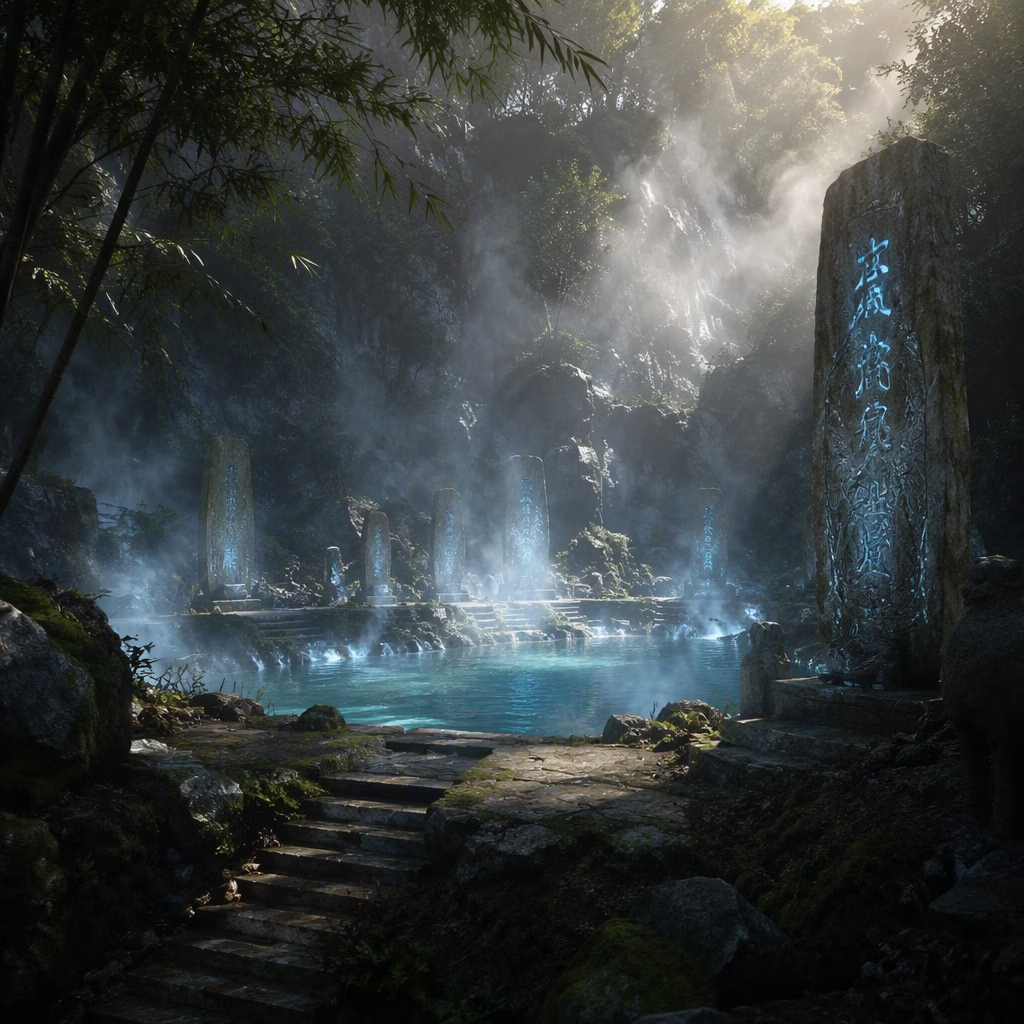
The environments are equally breathtaking. Brimming with personality, stages like the Ortiz Farm or the Descent into Subconscious aren’t mere backdrops — they’re living battlegrounds. Lumen, UE5’s fully dynamic global illumination system, means lighting reacts realistically to every explosion, every slow-motion hit. When Kazuya launches an opponent into a neon-lit Tokyo alley, the blue and pink billboards reflect off wet pavement and shimmer across his leather jacket in real time. Even environmental destruction, from shattering floors to crumbling pillars, unfolds with a physically believable weight that feeds directly into the competitive tension.
What often goes unappreciated is how the visual upgrade enhances gameplay clarity. Playing at my usual competitive pace, I need to read animations quickly. The fluidity of motion — enhanced by the engine’s ability to handle complex cloth physics and hair simulation without hitching — makes it easier to spot startup frames and react. King’s cape snaps into wild arcs behind him during jaguar dashes; Xiaoyu’s flowing ribbons trail her hypnotic movements with zero ghosting. All this crispness is served at a rock-solid 60 frames per second, even during the most particle-heavy super moves. It’s a technical marvel that blends spectacle with tournament-grade reliability.
The Rage Art sequences deserve their own essay. These cinematic climaxes are where Tekken 8’s visuals truly set a new benchmark. When Hwoarang lands his signature Rage Art, the camera sweeps around him in a jaw-dropping swirl of motion blur and fiery particles, before smashing into the opponent with a sound design that feels like thunder given form. The depth-of-field effects and smooth transitions between gameplay and real-time cinematics are so seamless I often forget a human hand is actually triggering these moments. Unreal Engine 5’s Niagara particle system delivers sparks, smoke, and energy trails that don’t just fly around — they interact with the scene, casting dynamic shadows and illuminating fighters during those precious few seconds of devastation.
Another area where Tekken 8 quietly dominates is facial animation. In my countless hours labbing matchups, I’ve grown addicted to the subtle expressions that flash across characters’ faces during stances or wins. Jin’s grimace when parrying low, Lili’s smug smirk after a sidestep — all rendered with an emotional fidelity that actually feeds my own mindset during matches. It’s a layer of visual storytelling I never knew competitive fighters needed until I experienced it.
From a technical standpoint, the customizability of the visuals on PC is also a treat. I’ve tinkered with the settings enough to know that even on lower-end hardware, the game retains a remarkable crispness thanks to UE5’s Temporal Super Resolution. But max it out, and the texture streaming is so efficient that I can pinpoint the threading pattern on Nina’s assassin suit during a close victory screen.
Two years after its launch, Tekken 8 remains a showcase for what Unreal Engine 5 can achieve in the fighting game genre. It isn’t just a game that happens to look good — it’s a title where visual excellence and competitive purity feed each other. Every punch, every kick, every glorious slow-motion finish reinforces why I’m still training daily. Because when a game looks this drop-dead gorgeous, every victory feels like art.